RUINS: PERFORMING QUEER HISTORY
Amy Adler, Ken Gonzales-Day, Cat Gunn, William E. Jones, Morgan Lieberman, Stephen Milner, Darian Newman, Matt Savitsky, and Joe Yorty
Curated by Nathan Storey
May 2 - June 13, 2026
RUINS: PERFORMING QUEER HISTORY, curated by Nathan Storey is an iterative exhibition of interdisciplinary artists reckoning with queer histories, archives, and loss within their contemporary studio practices. The artists in RUINS unearth LGBTQ+ histories, search for fragmentary pieces, and reimagine queer constellations. Archives are alive, pulsing with history, memory, and ruin. Simultaneously, they are fragmentary, evoking a longing for a time and place you cannot name. Archives bridge the past, present, and future, symbolic of the inevitability of our time slipping away, even as artists continue to gather, repair, and reimagine its remains.
This second iteration of RUINS surveyed intergenerational California-based artists whose works explore queer embodiment, intimacy, and space across drawing, photography, printmaking, sculpture, and painting. Spanning 1994 to 2026, the works in the exhibition trace queer history across generations, media, and shifting cultural contexts. California emerges here not only as place, but as a charged network of sites, bodies, and relationships: Black’s Beach in San Diego, Circus of Books in Los Angeles, The Stud in San Francisco, and other intimate social worlds of chosen family, collaboration, and desire.
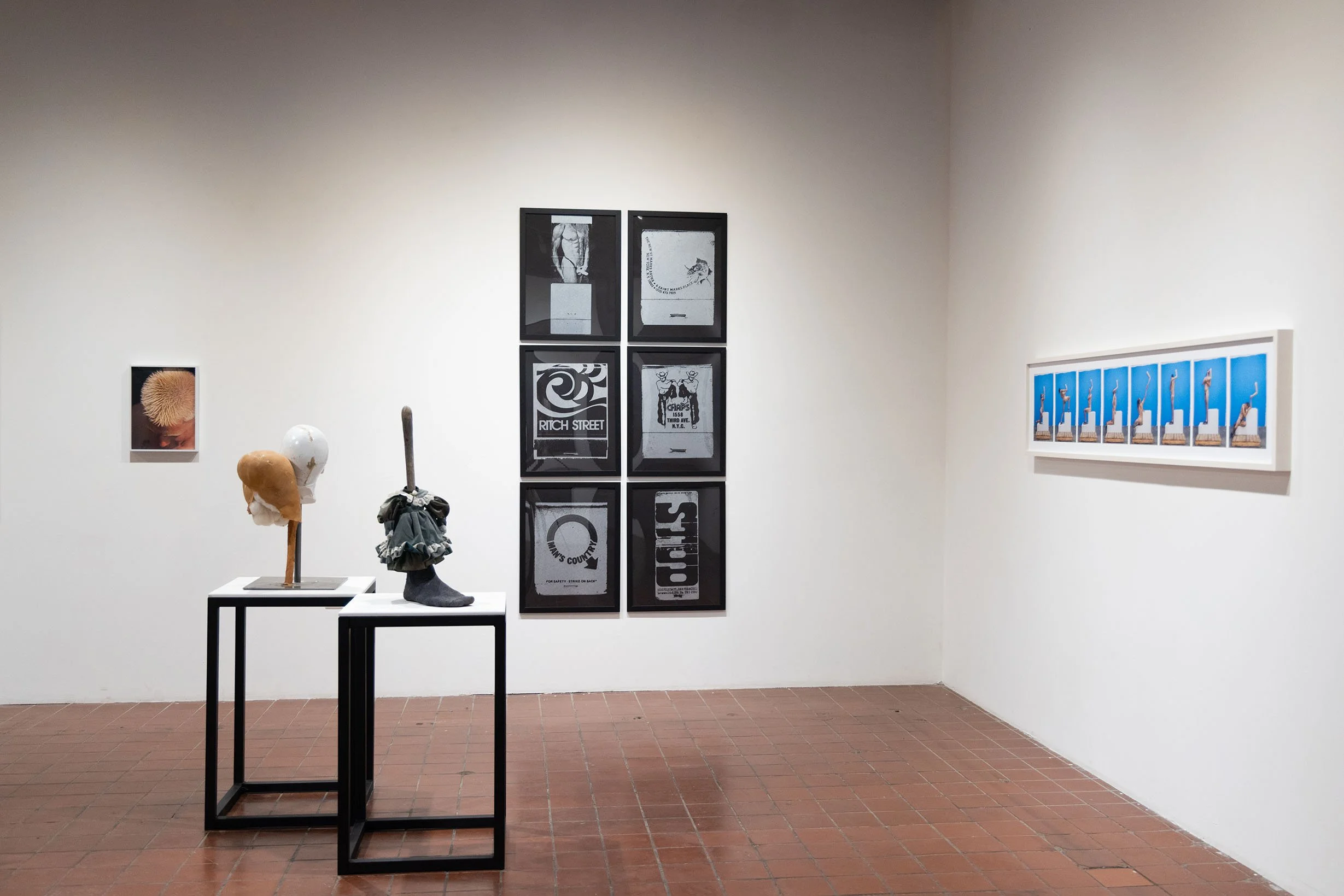
Within RUINS, queer history appears through ephemera, literary fragments, and images that have circulated through fragile and subcultural networks. Darian Newman’s Cruising revives matchbooks from gay bars and bathhouses, treating them as both print history and social archive: objects that carry the pleasure of going out, lighting a cigarette, exchanging a number, and inhabiting queer space. In this act of “un-archiving”, the matchbooks come out of drawers and boxes to live again, conjuring stories of queer gathering, contact, and desire for a new generation.
Amy Adler’s Jeff Burton Box Covers considers the charged afterlife of images, drawing from adult film box covers photographed by Jeff Burton and encountered through the worn, handled shelves of Circus of Books, the West Hollywood gay bookstore and pornography shop. Burton began his career as a photographer in the adult film industry before his work crossed into the art and fashion worlds. Adler made these drawings from a position of proximity and difference: she and Burton were close friends and neighbors in Silver Lake, and a walk together to Circus of Books revealed the video box covers he had shot. For Adler, the encounter opened a charged space of queer identification, urging her to draw images made by a gay man, circulating in a world she would not likely inhabit herself. In 2007, Adler stopped photographing and destroying her drawings and began drawing directly on canvas; these works are among the first from that shift. Here, drawing becomes a kind of ventriloquism: a way of occupying another, impossible body, while marking a major turning point in her practice.
Joe Yorty’s work turns to David Leavitt’s The Lost Language of Cranes, a novel set in 1980s New York during the AIDS epidemic, in which a father and adult son grapple with their queer identities. Yorty extracts the phrase “so blissfully easy” from a moment of sudden clarity amid personal calamity, after the father leaves his wife and sleeps on the floor of his son’s apartment. Reconstructed from found letters in a jagged, ad hoc arrangement, the phrase becomes tender and unstable: a fragment of queer recognition across generations, pieced together from remnants. Together, Newman, Adler, and Yorty trace how queer histories survive through printed matter, popular culture, and fragments of language, carried forward by touch, circulation, and recontextualization.
Ken Gonzales-Day and William E. Jones both engage the archive as a site of absence, invention, and historical instability. Gonzales-Day’s Bone-Grass Boy: The Secret Banks of the Conejos River constructs a fictional “nevermade” historical artifact in response to debates around AIDS, gay and transgender rights, immigration, the border, multiculturalism, and mixed racial identity in the late 1980s and early 1990s, at a time when work by Latinx artists was rarely exhibited. Set during the U.S.-Mexican War, the project follows Ramoncita, a Native/Latina two-spirit person, and Nepomuceno, a soldier, as they move through histories of displacement and violence. Through photography, performance, and narrative, the work challenges dominant histories of the American West and unsettles the boundaries between fact, fiction, and “evidence.”
William E. Jones’s two paintings in the exhibition, Male Hysteric and Mouth Held Open, begin from elusive archival and cinematic sources, including medical photography, male hysteria, Jean-Martin Charcot’s studies at the Salpêtrière, the visual legacy of Francis Bacon, and Jones’s own deep trove of gay pornographic imagery. Across film, video, photography, books, and painting, Jones has long returned to images that are marginal, degraded, surveilled, erotic, or difficult to place, tracing how gay desire often appears through materials already mediated by culture, surveillance, cinema, or the archive. Using a blurring technique that recalls photography and video while foregrounding the luminosity of oil paint, these works make representation feel unstable, tactile, and visceral, transforming images of male bodies into paintings charged with desire, discomfort, and the difficulty of historical recovery. Seen together, Gonzales-Day and Jones treat the archive not as a stable repository of truth, but as a field of projection, doubt, fantasy, and embodied encounter.
Morgan Lieberman and Stephen Milner turn toward queer visibility, intimacy, pleasure, and the social worlds that hold them. Lieberman’s Hidden Once, Hidden Twice honors senior lesbian partnerships across the United States, responding to the lack of visibility older lesbian women have faced across time. Her photographs of Gevin Fax and Cathy Tangum center a relationship shaped by survival, mobility, chosen family, and love, while also honoring Gevin’s place as a pioneer in the California riding community. In a newer body of work, Lieberman finds local lesbian couples in Los Angeles and stages photographs that pay homage to elder queer artists and iconic images from art history. In Two Women Dancing—Paying Homage to Robert Mapplethorpe, Lieberman reimagines Mapplethorpe’s Two Men Dancing through lesbian embodiment, shifting the image toward another lineage of queer intimacy, performance, and visibility.
Milner’s A Spiritual Good Time draws from surfing magazines published before 1990, cropping and recontextualizing mass-printed surf imagery into a meditation on pleasure, masculinity, and desire. The work also calls toward San Diego’s Black’s Beach, a site layered with histories of surfing, cruising, queer encounter, risk, and exposure. Milner’s photographs transform the visual language of surf culture into something more unstable and erotic, where athleticism, leisure, danger, and longing blur. Seen together, Lieberman and Milner expand the exhibition’s archival concerns into lived worlds of embodiment, pleasure, and longing.
Cat Gunn and Matt Savitsky approach queer history through ritual, transformation, and the performing body. Gunn’s ceramic garlic spiral imagines the altar as something that can appear anywhere, drawing from Filipino cooking, vampire folklore, and the aswang, a shapeshifting creature whose transformations become a way to think through transness, passing, safety, and racialization. Incorporating materials gathered from their queer community members here in San Diego—Anya’s rose incense, broken obsidian, and raw clay, alongside Quinn’s cherry pits and stems—the work becomes a collective ritual object, carrying traces of kinship, offering, and care. Garlic, often understood as protection, becomes a material of ritual care and bodily defense: a way to ward off threat, honor inheritance, and imagine survival through secrecy, transformation, and power.
Savitsky’s sculptures and performances emerge through life-casting and bodily fragments, using the cast body as prop, object, relic, and performative extension. His early studio performances with the left arm later developed into the broader Mid City Angels project, where the body becomes both material and mythic structure. Blending sculpture and performance-based processes, Savitsky defines the absent figure by creating form out of absence, probing questions of gender, the body, intimacy, and performativity. Through casting, repetition, and performance, he stages the body as unstable and theatrical: a site of projection, transformation, vulnerability, and excess. In both Gunn and Savitsky’s practices, the body is never fixed; it is cast, transformed, protected, haunted, and performed.
There is a current movement of queer artists looking backward and engaging with queer archives, legacies, and fragments within their contemporary studio practices. This deep preoccupation with the queer archive is, in part, due to the lingering and residual effects of the AIDS crisis: an utter catastrophe ignored and perpetuated by the United States government, leading to the loss of an entire generation — a crisis which, forty-five years later, is still not over. The urgency of this archival engagement is now inflamed as the Trump Administration again attempts to erase and remove traces of queer and gender-expansive histories, histories we know have always existed within any account of America. In RUINS, the afterlife of ephemera becomes a tactic of resistance. To perform queer history, to grapple with our collective pasts, is also to insist on queer futurity.